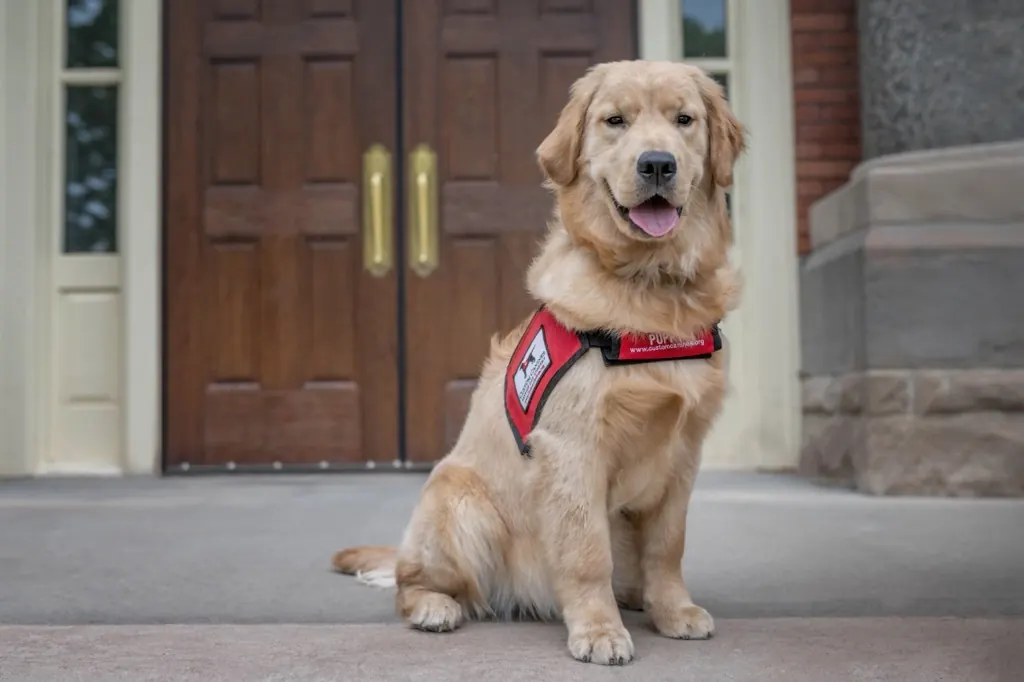
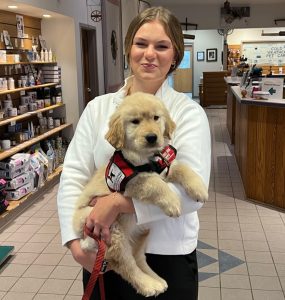
September is National Service Dog Month. For almost two years, I have been training a service dog for Custom Canine Service Academy in Madison, Wisconsin. This month is a great time to tell you what this experience has been like for Margo and me.
What is a service dog?
A service dog is an animal trained to perform specific tasks for a person with a disability. They are different from therapy dogs which accompany their owners in settings such as schools, hospitals, andnursing homes. Service dogs are also not the same as emotional support dogs, who provide companionship, and help with depression and anxiety but do not have special training to perform tasks.
As a service dog puppy raiser, my main responsibility has been to raise and train a golden retriever puppy named Margo, from 8 weeks until two years of age. The key areas we focused on are:
- Obedience Training
- Socialization & Manners
- Advanced Task Work
Basic Obedience Puppy Training
Everyone who has owned a puppy knows how time-intensive it can be to raise and train a puppy. This includes not only potty training but also basic manners and obedience commands. The same is true for raising a service dog puppy. However, we had to add many additional commands and expectations to our training list.
Not only did Margo need to know basic commands such as “sit,” “down,” “come,” and “stay,” but she also needed to learn commands such as “gentle,” “look,” “this way,” “drop it,” “visit,” “back up,” “quiet,” and “settle.” There are over 50 command words that we learn to teach the puppies. It has been fun to watch Margo learn and master so many different words. How many instruction words does your dog know?
Service dog puppies must learn to bring you their leashes, find different items, and pick up things to give to you. The puppies must also go under, through, and over objects. They also need to sit behind you or on either side of you when asked. We teach them to relieve themselves on command on multiple different surfaces because the dog may not be near grass when it’s time to go.
Socialization and Public Interaction
One of the crucial parts of successfully raising a puppy is adequate socialization a variety of circumstances. This helps instill confidence and calm in the puppies no matter what situations they may encounter in the future. Service dogs cannot be anxious or uncooperative.
As a puppy raiser, I received a three-page checklist of over 250 different types of things to expose Margo to during her training. This list included specific locations, noises, and smells. It also included a variety of people, sights, and sounds for Margo to experience in our time together. The goal was to acclimate the puppy to these situations in a positive way.
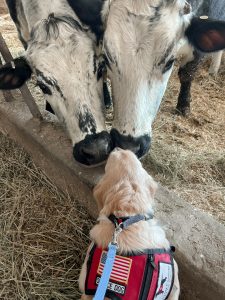
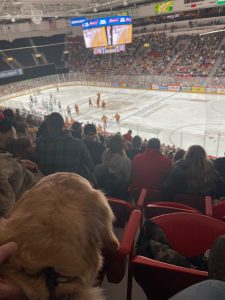
Margo and I have been on numerous outings, and she is an expert at shopping in any type of store. She has also mastered going to church, restaurants, and doctor appointments. She is now comfortable in crowds of people at events ranging from outdoor festivals and indoor theaters to sporting events.
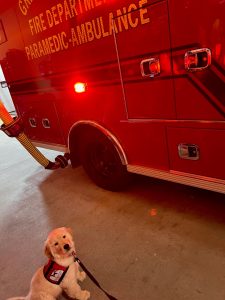
Additionally, Margo can navigate around medical equipment, construction equipment, and public transportation. She’s even comfortable with carnival rides even fire trucks!
A few of our more challenging introductions have included escalators, hot air balloons, and forklifts. But we were patient, and we used positive reinforcement so Margo could grow to be confident and comfortable in these environments.
Advanced Task Training
Once the puppies are 12-24 months of age, we start to teach them advanced tasks. At that time, I began to teach Margo specific commands she might need to help the veteran or first responder with whom she’ll live.
For example, “nudge” may alert a person of higher levels of anxiety. “Lap” tells Margo to put her front legs on my lap. This command will provide compression therapy for someone with PTSD. Additionally, “brace” will prepare Margo to stabilize her handler and absorb extra weight on her shoulders.
I’m currently working on more complicated tasks in the final stages of Margo’s training. At this point, I’m teaching Margo to bring me specific objects. We’re also working on “tug” to pull doors or items open. “Nose it” is the command for Margo to close something, and “find outside” directs her to locate an exit.
My Personal Experience
As I near the completion of training Margo to become a service dog, I realize I have thoroughly enjoyed this opportunity. Also, I have learned several things. Here are some of my biggest lessons:
Putting a little extra effort into puppy training helps any dog to have better manners and be more socialized. I have always said, “If you are not training them, then they are training you.” Make sure you train them to do what you want and not what they want.
I got a glimpse of what people with disabilities must experience on a daily basis. People had three different reactions when they saw me with Margo in places where pets aren’t normally allowed.
People who love dogs thought Margo was cute and wanted to say “hi.” These people had smiles on their faces, and you could see they loved animals.
The second type of responses were from people who were either wary of dogs or did not particularly like them. They would veer away from us to make sure to avoid any interaction. I can respect that, as pets are not for everyone. I made sure to be considerate so Margo wouldn’t disturb them.
The most surprising reaction that I received, more often than I ever imagined, were from people who looked me up and down. They gave me a look (or in some cases actually said to me) – “What is wrong with you that you need a service dog?”
- I realized that part of my mission was also to help educate people that not all disabilities are easily seen by the naked eye. Supporting and accepting people just as they are is much more helpful than judging them. People’s medical and health status is private information and should not be questioned by others.
The Future
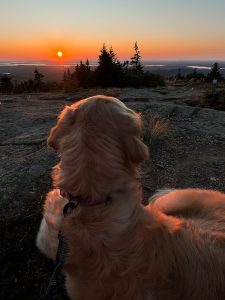
Many people have said that they could never do this, and they asked me how will I give Margo up? I love Margo. I know I will cry, and I will miss her when she is gone. But, I also know that there is a higher purpose to what we have accomplished. Someone who is in need will have a better life because of the time and effort we took to help Margo become a successful service dog.
I raised Margo in honor of my son, Kyle, who enlisted in the Marines. Tragically, he died in a car accident two weeks before he was to leave for boot camp. I wanted to find a way to support the men and women of our armed forces who sacrificed so much for us.
I hope other people find it in their hearts to consider volunteering to raise a puppy for someone else someday. There is currently a five-year waiting list for people at the academy needing service dogs. The biggest hurdle is finding people to help raise the puppies.
A special thank you to my daughter, Nicole, who has been instrumental in helping to train Margo. Thank you, also, to the Countrycare team who also participated in her training process. I am honored to have been a part of the Custom Canine Service Academy team, and I appreciate all they did to support us and all of those who are in need.